The Dutch Clay Pipe: Handbook for Identification
The latest book by pipe expert Don Duco
The Dutch Clay Pipe systematically describes the evolution of the clay pipe over four centuries. From the rise of the Netherlands as a trading nation to the industrialisation of society, the tobacco pipe continually changed with the times, as does every utilitarian object. Due to its widespread use throughout history and its fragility, the clay pipe is still the most frequently encountered archaeological find.
Duco describes not only the pipe's shape and decoration but also offers, for the first time, a detailed interpretation. He goes so far that we can even learn something about the smokers who used particular types of pipes.
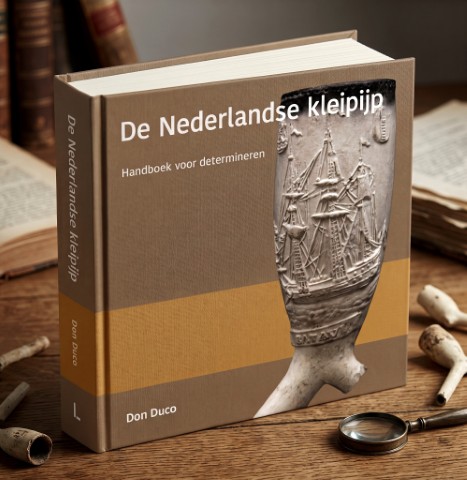
Why did pipe bowls gradually become larger, and why did their shapes change? The development of the pipe bowl is an important key to dating. The way a pipe was finished by hand tells us a great deal about its quality, but how can these characteristics be recognised?
The city of Gouda played a central role and largely determined the fashion for pipe shapes. At the same time, this book shows which regional variations existed and how to recognise them. Numerous illustrations make the book a useful and comprehensive reference work.
The pipe was handmade, but it was produced as a mass-market product. By engraving the moulds, pipes can quickly be decorated with current images. These could reach people throughout the country in a short time. Long before the arrival of machines, this made the clay pipe an early form of mass media. For example, news about the appointment of a stadtholder or the birth of a prince could be widely circulated through pipe decoration.
The Dutch Clay Pipe pays extensive attention to the decorated pipes. The author explains the images, places them in their historical context, and shows which groups of people the pipes were intended for. This is a new area of historical research that gives archaeological pipe finds a deeper meaning. A great many illustrations allow readers to look, study and compare them with their own finds.
Duco has incorporated many new insights into this book. Using archival records and research into the museum collection, he has been able to reconstruct the original length of pipe stems. Never before has it been shown so clearly that there is a strict system governing the relationship between the pipe bowl, stem length and quality of the pipe. Gouda's pipe makers followed an exceptionally disciplined method of working, with the result that their handmade production was already industrial, long before the word 'industrial' was used in this sense. This knowledge is explained in detail in this new handbook. As a bonus, Duco reveals the original sales prices of the various pipes.
For researchers who want to take their studies further, the final chapter is dedicated to the interpre-tation of finds. Duco provides clear guidance on what can be learned from a group of pipes found together - the so-called find complex. Such an assemblage may show which types and shapes were made by a particular pipe maker – the product range. Alternatively, the pipes may have belonged to a single smoker or household – the user group. This brings the consumer into the picture as the person who actually smoked the pipe. A keen observer can even discern how the smoker treated his pipes: was he careful and thrifty, or careless and wasteful? Ideally, it may be possible to determine the smoker's social position. Did the pipe fit that position, or was he using it to give the impression that he was better off than he really was?
Fortunately, the book also provides useful tools for the less experienced researcher, alongside its many illustrations. The deductive identification system developed by Duco provides a framework covering all the physical characteristics of a clay pipe, such as its shape, finish and additional treatments. Each characteristic is linked to a clear timeline. By recording as many characteristics of a find as possible and combining the periods in which they occur, the overlap in time periods will result in an increasingly precise dating. This system, introduced by Duco in 1987, has now been further expanded and refined.
The close integration of text and images builds knowledge step by step, which means that anyone who uses The Dutch Clay Pipe can learn to identify pipes independently. Don Duco, the leading pipe expert for many years, has created a true handbook with this extensive and systematically organised book. It will be of great value to today's researchers as well as to future generations. It is the perfect companion to Duco's earlier standard work “Merken en Merkenrecht van de pijpenmakers in Gouda” (Marks and Ordinances of Gouda Pipe Makers) published in 2003.
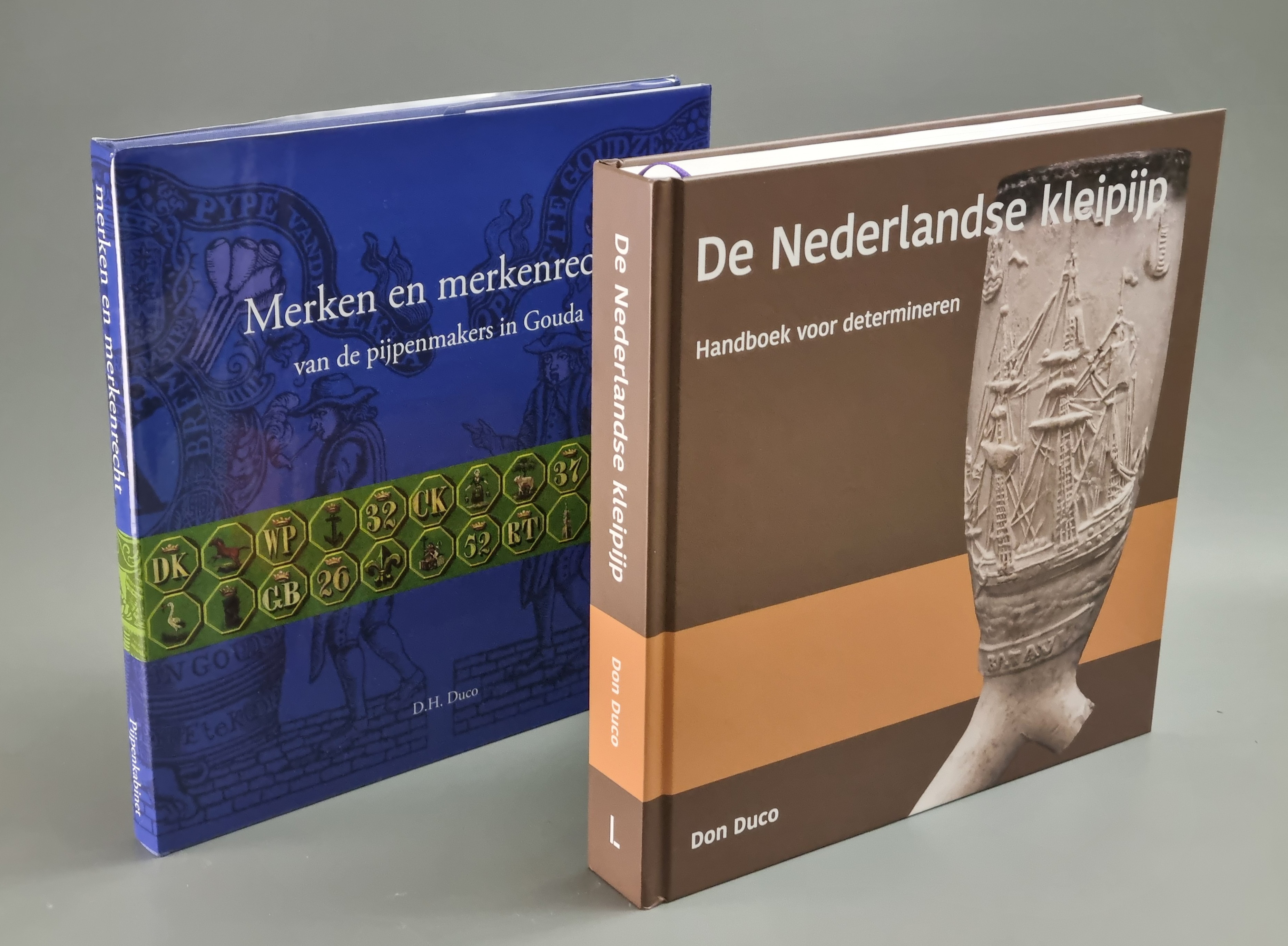
The Dutch Clay Pipe teaches you how to look, recognise, date and interpret. A pipe bowl is more than a piece of pottery – it is a key to the past. After all, the purpose of history is to understand the past and, in doing so, to tell its stories. This book is the tool for doing just that.
Specifications: The Dutch Clay Pipe - Dutch title: De Nederlandse kleipijp
Format: bound, hardcover
Size: 464 pages
Dimensions: 30 x 30 cm
Illustrations: 2,200 photos
ISBN: 9789462265820
language: Dutch, incl. short English summary
Publication date: October 2026
Price foreign countries: € 75.-